
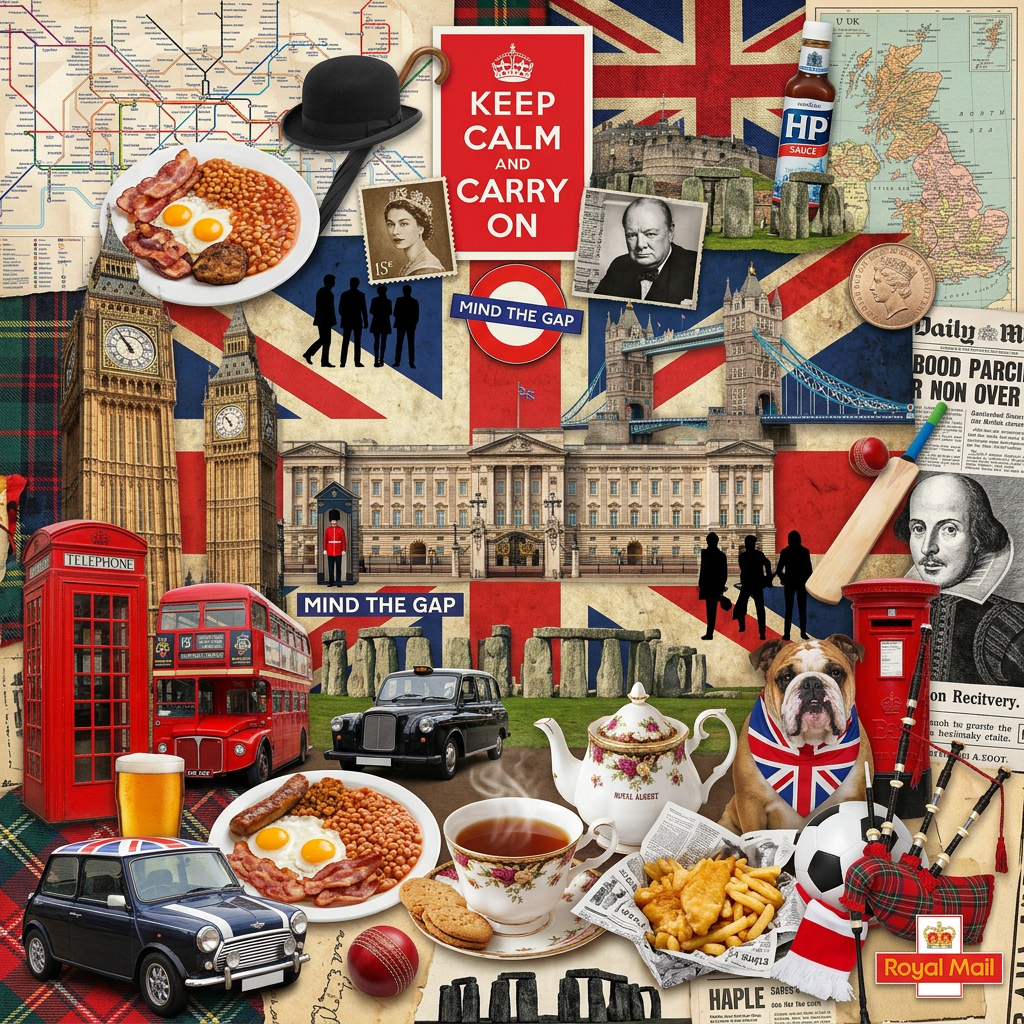
A multicultural island, shaped by a long and layered history. Often described as secular and tolerant, with values of respect, politeness, and fair play. Four nations forming a union, each proud of its own roots, culture, identity and past – yet bound together under a shared name. The image of Britain is often one of green rolling hills, woodland stretching behind a small country village, and a church standing quietly at its centre. A community fair, a country pub, a pint pulled steady, unhurried and tempered, much like the weather. Yet this is only one version. It exists alongside the bustling, post-industrial towns and cities of the north, shaped by labour, migration, and change. Britain is not one image, but many. Less a single story, and more a land of contrast.
Even the language reflects this. At times indirect, layered, and ironic, it allows for humour that is dry, self-deprecating, and occasionally absurd. There is a tendency toward moderation and reservation, yet this sits uneasily beside moments of boldness, eccentricity, and even bluntness. The national character, like the landscape, resists simplicity. And within this identity lies something more personal. National identity does not only shape how we see our country, but how we see ourselves within it. To feel that one belongs to feel at home in a shared identity can offer a quiet sense of stability and connection. It can ground people, giving meaning to their place in the world and strengthening their sense of wellbeing.
Yet identity can also carry unspoken expectations. In a culture that often values stoicism, understatement, and humour in the face of difficulty, it can be harder to speak openly about struggle. The same traits that bring people together can, at times, discourage vulnerability. What is celebrated as resilience may also become silence.
For others, the question of belonging is more uncertain. When national identity feels narrow or exclusive, shaped by ideas of colour, creed, or class, it can leave people feeling outsiders in their own home. Britain has always been connected to the wider world; through migration, trade, and cultural exchange and its identity has never been fixed. Yet not everyone experiences that openness equally. Inclusion is not just a political idea, but a deeply personal one, shaping confidence, connection, and mental wellbeing.
There is much in Britain’s history to admire: its contributions to science, engineering, language, art, and culture. At the same time, its imperial past cannot be ignored, a history of expansion that came at the cost of others’ lands, resources, and lives. These histories sit side by side, shaping how the nation sees itself and how it is seen by others. To be British, then, is not to fit a single definition. It is an identity shaped by contrast, by shared values and competing narratives, by pride and reflection, by unity and difference. Perhaps it is not contradiction that defines Britain, but coexistence.
No one should feel unwelcome or out of place in the country they call home. There is something deeply British in the ideal of tolerance and fairness but ideals only matter when they are lived. To accept difference, to challenge one another with compassion, and to widen the sense of belonging is not just a social goal, but a human one. Because a nation’s identity is not only measured by its history or its values, but by how it allows its people to live, to belong, and to be well.


Leave a Reply